Zero Dimensional Symmetry - only one symmetry here - pointic, no need to split into kingdoms.
One Dimensional Symmetries - only two symmetries - dyadic and monic, no need to split into kingdoms. Dyadic symmetry is the apex symmetry in 1-D.
Two Dimensional Symmetries - finally something somewhat interesting, here we have one kingdom - the polygonal symmetry kingdom. There are two symmetries based on each integer, one with reflections (n-gonal) and one without (n-kigonal). We can also include the continuum (round) symmetries - cyclic and kicyclic.
Three Dimensional Symmetries - We split these into two kingdoms - 1. Polyhedral Symmetry Kingdom and 2. Axial Symmetry Kingdom.
1. Polyhedral Symmetry Kingdom - There are seven symmetries plus two round symmetries, these symmetries keep all three dimensions together without splitting them, we can denote this as the (3) cases. This kingdom has two families - cubic, and doic as well as the round family - spheric. The cubic family includes cubic, kicubic, pyritic, tettic, and kitettic (tet is the demicube). The doic family includes doic and kidoic symmetries. The spheric family includes spheric and kispheric symmetries. There are two apex symmetries - cubic and doic.
2. Axial Symmetry Kingdom - These are the prismatic, antiprismatic, and pyramid symmetries - AKA the (21) cases for they split the dimensions into 2 and 1. For each integer greater than 1, there are seven axial symmetries (prismic, proprismic, kiprismic, apic (antiprismic), proapic, pyric (pyramid), and kipyric). There are only three unique symmetries for the integer 1 (monic, dyadic, and inversic). There are also five round symmetries based on the cylinder and cone. I use the O symbol for round symmetries, we can consider it as either 0 or infinity. The round symmetries are cylic, kicylic, procylic, conic, and kiconic.
A great in depth reference for these symmetries is Towards a Geometric Understanding of the 4-Dimensional Point Groups by Laith Rastanawi and Gunter Rote in 2022, this helped me sort out kingdoms 4-6. For kingdoms 4-6, I use symbols found in the mentioned paper where \ denotes a slant in a square, X is an X in a square, G is for the swapturn symmetry group, + is a plus in a square, X+ is a square with an X and + together, * is a dot in a square, (_) is a blank square, and | is a bar in a square, they come from table 6 on page 52 in the paper. In the 6-D section, I show a graphic with the cube versions of these for tritoroidal groups.
1. Polychoric Symmetry Kingdom - There are 22 symmetries here plus two round symmetries, these symmetries keep all four dimensions together without splitting them - type (4). This kingdom has four families - pennic, tessic, icoic, and hyic as well as the round family - glomic. The pennic family includes pennic, kipennic, decaic, kidecaic, and iodecaic symmetries. The tessic family includes tessic, kitessic, demitessic, kidemitessic, and tessipyritic symmetries. The icoic family includes icoic, kiicoic, icopyritic, contic, kicontic, iocontic, toxitic, and oxitic symmetries. The hyic family includes hyic, kihyic, ixitic, and ixoic symmetries. The glomic family includes glomic and kiglomic symmetries. Apex symmetries are hyic, contic, and ixoic.
2. Polyhedral Axial Symmetry Kingdom - These are the (31) cases, which are the symmetries of prisms, antiprisms, and pyramids of polyhedra. There are two major families (cupic and dopic) plus one round family which includes 21 symmetries plus 5 round ones. The round symmetries are based on the spherinder and sphone (spherical cone) which are sphindic, prosphindic, kisphindic, sphonic, and kisphonic. The cupic family includes, cupic, procupic, kicupic, pyripic, pyrapic, cupyric, kicupyric, pyritopyric, tepic, protepic, kitepic, tetapic, protetapic, kitetapic, tetpyric, and kitetpyric. The dopic family includes dopic, prodopic, kidopic, dopyric, and kidopyric symmetries.
3. Swirlchoric Symmetry Kingdom - These are the swirl symmetries which are refered to as tubular symmetries in the point group article, these can be very strange looking. There are eleven infinite series which ends in seven unique polytwister symmetries plus two round symmetries, these symmetries are globally (4) type but locally (31) type. The 11 series can be split into the swirldoics, swirltettics, and swirlcubics (click the three words 'swirlchoric', 'symmetry', and 'kingdom' above for each group). The swirldoics include swirldoic and skidoic series which lead to doteric and kidoteric polytwister series. 1-swirldoic is the same as 2-skidoic, 5-swirldoic is the symmetry of sisp and gisp. The swirltettics include stettic, skitettic, astettic, and askitettic symmetry series which lead to tetteric and kitetteric polytwister symmetries, the ones starting with 'a' (alternate cases) lead to the same polytwister symmetries as the first two series. The spyritic series could also go here or with the swirlcubics, it leads to the pyriter polytwister symmetry. 1-spyritic is the same as 2 skitettic. The swirlcubics include scubic, skicubic, ascubic, and askicubic series which lead to the cubiteric and kicubiteric polytwister symmetries. 1-stettic is the same as 1-askicubic. Also 1-scubic = 1-ascubic = 2-skicubic. The round symmetries are hopfic and kihopfic symmetries.
4. Ortho-Toroidal Symmetry Kingdom - These are the (22) cases which are formed by rolling a symmetry square with an ortho-aligned wallpaper group into a torus. This is the most versatile kingdom and deals with the duoprism symmetries and their friends. Included here are the pyramids of prisms and antiprisms, the no symmetry case, and the extended duoprisms which occur in powertopes. They can be subdivided into five sub-kingdoms - the duoprisms, duoantiprisms, mixed, extended, and two swapturn cases (b=0 and a=b cases). The duoprism cases are the dippic, prodippic, dukipic, and kidippic symmetries which require two numbers greater or equal to 1, these also include round cases where one or both numbers are O (duocylinder and prisminder symmetries). Except for prodippic, m-n symmetry = n-m symmetry. 1,1-dippic, 1,1-kidippic, and 2,1-kidippic are repeats of other symmetries. Dippics are the duoprism symmetries - the +p2mm cases, prodippic are the |pm cases, dukipic are the _ cases, and kidippic are the * cases. The duoantiprism cases include dappic (duoantiprisms), prodappic, dukappic, and iodappic cases where m,n are any positive integer. m,n = n,m for dappic and iodappic - when both are 1, then it repeats another symmetry. Dappics are the +c2mm cases, prodappic are the |cm cases, dukappic are some of the _ cases, and iodappics are the +p2gg cases. For the mixed type, there are the adippic, proadippic, and dugypic where m,n are any integer. for dugypic m,n=n,m. 1,1-adippic repeats another symmetry. Adippic are the +p2mg cases, proadippic are the |pg cases, and dugypics are some of the * cases. The extended cases are the exdippic, exdappic, exadapic, and exiodappic cases, they only need one number (n). Exdippic (n>2,O) are the X+ p4mmU cases. Exdappic (n>1) are the X+p4mmS cases. Exadapic (n>1) are the X+p4gmS cases, the symmetry of the grand antiprism belongs to this group. Exiodappic (n>2) are the X+p4gmU cases. The swapturn cases are the iodippic (n>2) - Gn,0 and iodugypic (n>1) - Gn,n. For \ and X cases where m=n, they could also land in this kingdom, but I desided to put these in kingdom 5. So there are 17 types of symmetries here, 11 of them need two variables, the other 6 need one. 1,1-dukipic is the no symmetry case.
5. Swirl-Toroidal Symmetry Kingdom - These are the (22) cases which are formed by rolling a symmetry square with a diagonally aligned wallpaper group into a torus, they include swirl versions of prismattic, pyramid, and antiprismattic symmetries. In the point group paper, they included some of the first two toroidal groups (the diagonally oriented ones - skipyric and spyric symmetries for swirl chiropyramid and swirl pyramid) and the \ and X groups. I coined names for these symmetries using 'sl' for 'slant' which are the '\' cases and 'x' for the X cases and the letters after the symbol - hince names like slipamic (\pm), slipagic (\pg), slicamic (\cm), xapmimic (Xp2mm), xapmagic (Xp2mg), xapgagic (Xp2gg), and xacmimic (Xc2mm) symmetries. There are nine symmetry types here all requiring two numbers m,n. Skipyric (_) and spyric (*) are swirl versions of kipyric and pyric symmetries. Slipamic are swirl proprismic or swirl kiprismic depending on which integer you start with m or n. Slipagic are swirl kiantiprismic / proantiprismic. Slicamic are alternate swirl proprismic / alternate swirl kiprismic. Xapmimic (m>=n>1) are swirlprismic cases. Xapmagic (m,n>1) are the swirl prismic/antiprismic cases. Xapgagic (m>=n>1) are the swirl antiprism cases. Xacmimic (m>=n>2, m-n even) are the alternate swirlprismic cases. Many of these also have rounded versions where 1 or both m and n are O. Each of the axial symmetries in 3-D generate a polytwister symmetry here.
6. Gyro-Toroidal Symmetry Kingdom - These are the (22) cases which are formed by rolling a symmetry square with oblique oriented wallpaper groups into a torus. These are kigyroic (_), gyroic (*), and bigyroic (Ga,b) symmetries (these are the kisquare bigyros which inlclude the 13,5 case = G3,2). They are the remaining of the first two groups in the paper and the general swapturn group where a>b>0. The Ga,b (a>b>0) is the a^2+b^2,a+b-bigyro symmetry. They can also be called a,b-swapturnic symmetry. The other bigyro symmetries (rhombic type) turn out to be kingdom 5 symmetries. Round symmetries also show up, they are the kicoiloids (rounded kigyrioic) and coiloid (rounded gyroic) symmetries which require two numbers.
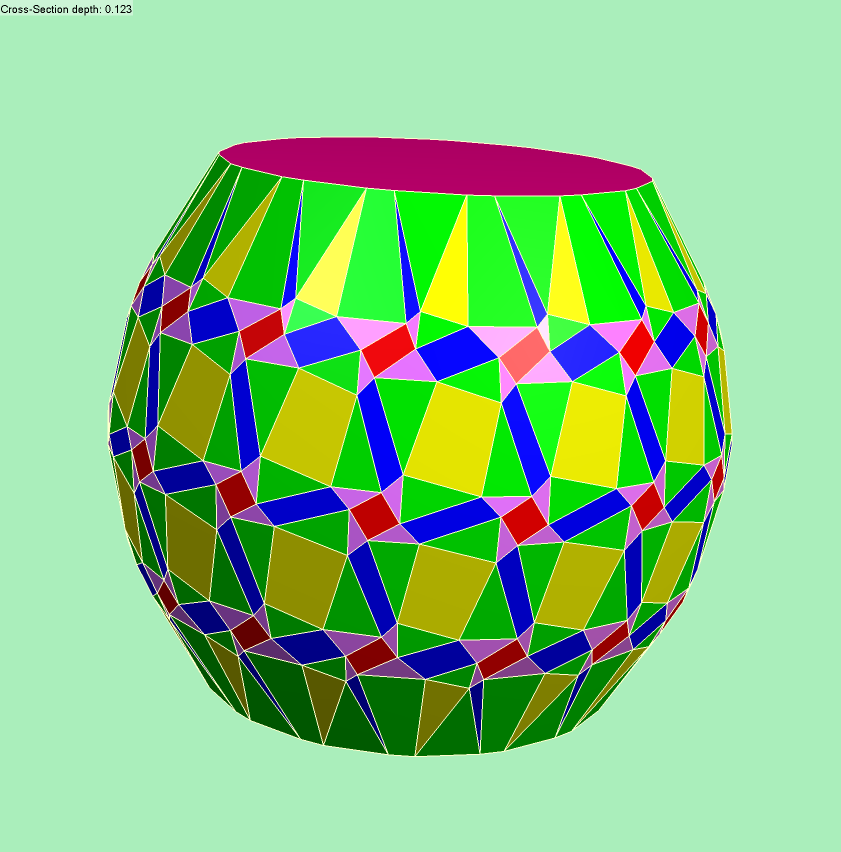
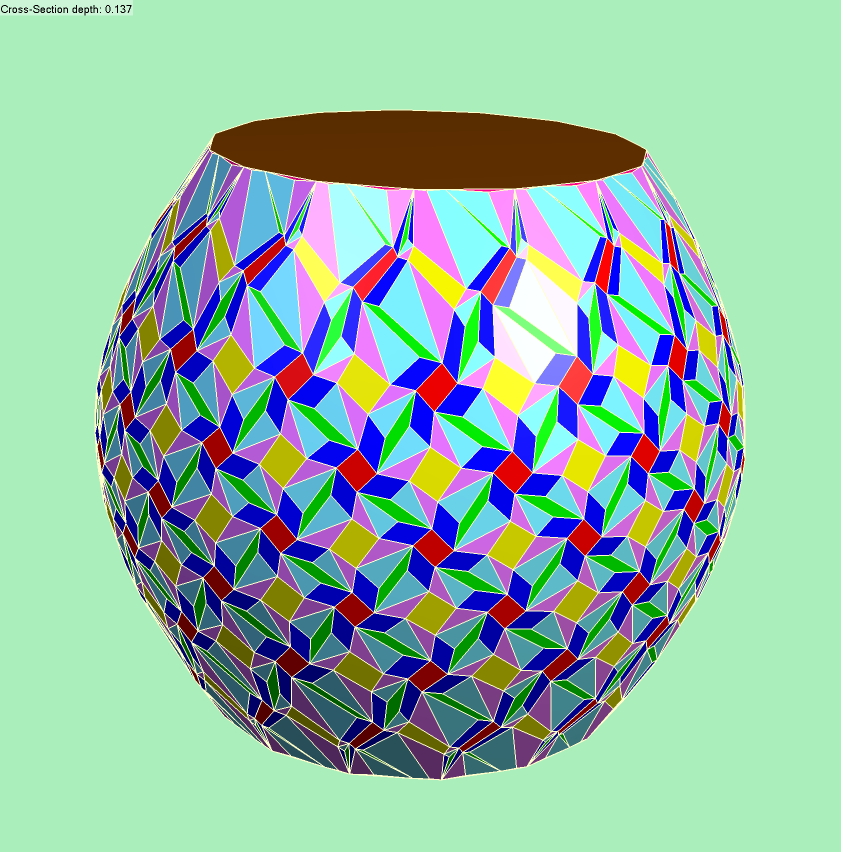
Below shows examples of iodippic and iodugypic symmetries from kingdom 4.
1. Polyteric Symmetry Kingdom - There are 16 symmetries plus two round symmetries, these symmetries keep all five dimensions together without splitting them, aka the (5) cases. This kingdom has two families - hixic and pentic as well as the round family - pentorbic. The hixic family includes hixic, kihixic, dottic, kidottic, iodottic, skewhixic, and skewdottic. The pentic family includes pentic, kipentic, pentipyritic, hinnic, kihinnic, gyropentic, kigyropentic, gyrohinnic, and kigyrohinnic symmetries. The spheric family includes pentorbic and kipentorbic symmetries. Apex symmetries appear to be pentic and dottic from kingdom 1 and hipic, contipic, and ixopic from kingdom 2.
2. Polychoric Axial Symmetry Kingdom - These are the (41) cases, there are four families plus a round family - this has 69 symmetries plus 5 round ones. The round symmetries are glomindic, kiglomindic, proglomindic, glonic, and kiglonic. The four families are the penpic, tespic, icopic, and hipic families. The penpic family includes 16 symmetries - penpic, propenpic, kipenpic, pennapic, propennapic, kipennapic, penpyric, kipenpyric, decapic, prodecapic, kidecapic, iodecapic, iodeca'apic, decapyric, iodecapyric, and kidecapyric symmetries. The tespic family includes these 16 symmetries - tespic, protespic, kitespic, tespyric, kitespyric, demitespic, prodemitespic, kidemitespic, demitespyric, kidemitespyric, tessipyripic, tessipyrapic, tessipyritpyric, demitesapic, kidemitesapic, and prodemitesapic. The hipic family includes these ten symmetries - hipic, prohipic, kihipic, hipyric, kihipyric, ixitipic, ixitapic, ixitpyric, ixopic, and ixopyric symmetries. The icopic family includes 27 symmetries - icopic, proicopic, kiicopic, icopyric, kiicopyric, contipic, procontipic, kicontipic, icoapic, kiicoapic, proicoapic, contpyric, iocontpyric, kicontpyric, iocontipic, iocontapic, icopyripic, icopyrapic, icopyritpyric, toxitipic, oxitipic, toxitapic, toxitpyric, oxitpyric, oxitapic, iotoxitipic, and kitoxitipic.
3. Swirlchoric Axial Symmetry Kingdom - These are globally (41), but locally (311) cases. There are 40 infinite series of symmetries here, many capping with a polytwister axial symmetry. There are also Hopf axial round symmetries - aka - hopfindic, prohopfindic, kihopfindic, hopfonic, and kihopfonic. The 40 series can be split into four subkingdoms - pyramids, prisms, antiprisms, and others. There are 11 series in the pyramid subkingdom - swirldopyric, skidopyric, scupyric, skicupyric, ascupyric, askicupyric, spyritipyric, stetpyric, skitetpyric, astetpyric, and askitetpyric - seven polytwister pyramid symmetries cap these (excluding the altered ones - starts with 'a') - doterpyric, kidoterpyric, cubiterpyric, kicubiterpyric, pyriterpyric, tetterpyric, and kitetterpyric - each of the 11 series needs one number 'n'. There are also 11 series in the prism subkingdom - swirldopic, skidopic, scupic, skicupic, ascupic, askicupic, spyripic, stepic, skitepic, astepic, and askitepic, the non-altered ones caps at polytwistinder symmetries - doterindic, prodoterindic, cubiterindic, procubiterindic, pyriterindic, tetterindic, and protetterindic. These series also need one number 'n'. The antiprism kingdom has 9 series, the two altered cubic ones crash, the girdles of the top and bottom swirlchora line up but with an alternating nature - (aka n-skidoic/2n-skidoic). These are the swirldoapic, skidoapic, scubapic, skicubapic, spyrapic, stetapic, skitetapic, astetapic, and askitetapic, the first seven caps with these - doterindic, prodoterindic, cubiterindic, prodoterindic, pyriterindic, tetterindic, and protetterindic (which are repeats). These 9 series also need one number 'n'. The mixed ones have 9 series which also need one number 'n'. These are kiswirldopic (skidoic/swirldoic), kiscupic (skicubic/scubic), antispyripic (spyritic/scubic), antistepic (stettic/scubic), kistepic (skitettic/stettic), proantistepic (skitettic/spyritic), antiskitepic (skitettic/skicubic), kiascupic (askicubic/ascubic), kiastepic (askitettic/astettic) - the first 7 caps with these round cases - kidoterindic, kicubiterindic, antipyriterindic, antitetterindic, kitetterindic, antikitetterindic, and antiprotetterindic.
4. Gonihedral Symmetry Kingdom - These are the (32) cases. There are 42 infinite series requiring one integer 'n', many of these caps with a O round case. There are also 7 infinite spheric series, some of these capping with a cyclic case making them doubly round - cyclospheric cases. These can be grouped into the single-style (14 series plus four round series - 7x2 + 2x2), double-style (18 series plus 3 round series - 6x3 + 1x3), and triple style (10 series - 5x2). The single-styles are pure polygon-polyhedral duoprism symmetries. They are gontettic, progontettic, gonkitettic, kigontettic, goncubic, progoncubic, gonkicubic, kigoncubic, gonpyritic, progonpyritic, gondoic, progondoic, gonkidoic, and kigondoic. They cap with cyclic cases - cyclotettic, procyclotettic, cyclokitettic, kicyclotettic, cyclocubic, procyclocubic, cyclokicubic, kicyclocubic, cyclopyritic, procyclopyritic, cyclodoic, procyclodoic, cyclokidoic, and kicyclodoic. The four round single-style series are gonspheric, progonspheric, gonkispheric, kigonspheric which cap in double round cyclospheric, procyclospheric, cyclokispheric, and kicyclospheric.
The double-style have an alternating feature going on.
The triple-style cycle between three orientations.
5. Ortho-Toroidal Axial Symmetry Kingdom -
6. Swirl-Toroidal Axial Symmetry Kingdom -
7. Gyro-Toroidal Axial Symmetry Kingdom -
A good rule for axial symmetries, is to look for all possible symmetry doublings - for example ixoic is a doubling of ixitic - so we could have a 5-D symmetry where the two caps have ixitic symmetry, but the projection of the two caps has ixoic (this is ixitapic symmetry). Of course we also have direct prisms and pyramid symmetries that go with these 'doublings'.
Below shows the tritoroidal types similar to the toroidal types on page 52 in the 4-D point group paper. These will result in kingdoms 8-13.

1. Polypetic Symmetry Kingdom -
2. Polyteric Axial Symmetry Kingdom -
3. Swirlpetic Symmetry Kingdom -
4. Gonichoric Symmetry Kingdom -
5. Gonaswirlchoric Symmetry Kingdom -
6. Double Hedral Symmetry Kingdom -
7. Gonahedral Axial Symmetry Kingdom -
8. Ortho-Tritoroidal Symmetry Kingdom -
9. Swirl-Tritoroidal Symmetry Kingdom -
10. Trigonal-Tritoroidal Symmetry Kingdom -
11. Orthogyro-Tritoroidal Symmetry Kingdom -
12. Swirlgyro-Tritoroidal Symmetry Kingdom -
13. Trigyro-Tritoroidal Symmetry Kingdom -
1. Polyectic Symmetry Kingdom -
2. Polypetic Axial Symmetry Kingdom -
3. Swirlpetic Axial Symmetry Kingdom -
4. Goniteric Symmetry Kingdom -
5. Hedrachoric Symmetry Kingdom -
6. Hedraswirlchoric Symmetry Kingdom -
7. Gonachoric Axial Symmetry Kingdom -
8. Gonaswirlchoric Axial Symmetry Kingdom -
9. Double Hedral Axial Symmetry Kingdom -
10. Hedraortho-Toroidal Symmetry Kingdom -
11. Hedraswirl-Toroidal Symmetry Kingdom -
12. Hedragyro-Toroidal Symmetry Kingdom -
13. Ortho-Tritoroidal Axial Symmetry Kingdom -
14. Swirl-Tritoroidal Axial Symmetry Kingdom -
15. Trigonal-Tritoroidal Axial Symmetry Kingdom -
16. Orthogyro-Tritoroidal Axial Symmetry Kingdom -
17. Swirlgyro-Tritoroidal Axial Symmetry Kingdom -
18. Trigyro-Tritoroidal Axial Symmetry Kingdom -
Back to Polychoron Site . . . Home Page . . . Four Dimensional Symmetries

Page created by Jonathan Bowers, 2024
e-mail = hedrondude at suddenlink dot net