


These are the symmetries that Conway refered to as 1/2[O x D2n]. As n approaches infinity, these symmetries approach tetteric symmetry. I coded these using the quarternion sets ico1 x cn1 and ico2 x cn2. When N is even, then there are six swirl rings with 2N symmetry which contains two sets of 12N points with kibrick symmetry and the rings generate 24N essic areas. When N is odd, the six swirl rings are ghosted and form girdles in white space instead and the points vanish, these girdles have skewed 4N symmetry. When N is divisible by 3, then there are four sets of 8N points with kitrippic symmetry and two sets of four swirl rings with 2N symmetry, these form 16N kitrigic areas for each ring set (4N spots per ring). When N is not divisible by 3, then the points here vanish and the rings are ghosted into white space, but do form girdles with 6N/3 gyrogon symmetry. White space creates 48N no sym areas. There are also two sets of 6N cross rings with rectic symmetry when N is even and one set of 12N cross rings with essic symmetry when odd.
1-Stettic Symmetry - [3,3:1] order 48. Same as 1-askicubic. White space generates 48 no sym areas. There are two sets of four ghost ring girdles with 6/3-gyrogonal symmetry and a set of six ghost ring girdles with skewsquare symmetry. There are 12 cross rings with essic symmetry generating 24 essic locations.
2-Stettic Symmetry - [3,3:2] order 96. It has two sets of 24 points with kibrick symmetry. It has two sets of four girdles (ghost rings) with 12/3-gyrogonal symmetry. It has six swirling rings with square symmetry generating 48 essic spots which goes through the two types of points. It also has two sets of 12 cross rings with rectangle symmetry which generate 48 essic spots. Both types of cross rings goes through both types of points generating a triaxial cross where they meet the swirling rings. White space generates 96 no sym spots.


3-Stettic Symmetry - [3,3:3] order 144. It has four sets of 24 points which have kitrippic symmetry. It has 6 girdles (ghost ring which is part of white space) with skew-dodecagonic symmetry. It has two sets of four rings that swirl about each other with hexagonal symmetry which generate 48 kitrigonal regions (12 per ring). It has 36 cross rings with essic symmetry which generate 72 essic regions. Each of the swirl rings have three cross rings meeting in triplicate at two opposite points, there are six triples of rings (18 in all) that meet at each swirl ring. White space generates 144 no sym spots.


4-Stettic Symmetry - [3,3:4] order 192. It has two sets of 48 points which have kibrick symmetry. There are two sets of four girdles which doesn't form rings, these have 24/3-gyrogon symmetry. It has six swirling rings with octagonal symmetry which generate 96 spots with essic symmetry, these go through both types of points. It also has two sets of 24 crossing rings with rectic symmetry which generate 96 essic locations each one goes through one of the point types each. The white space generates 192 no symmetric spots.


5-Stettic Symmetry - [3,3:5] order 240. It has two sets of four swirling girdles with 30/3-gyrogonal symmetry. There are also six swirling girdles with skew icosagonal symmetry. These girdles doesn't form rings they are part of the 'white space' where no symmetry areas reside. There are however 60 cross rings with essic symmetry generating 120 spots all together with essic symmetric. All other spots (the 'white space') form 240 areas with no symmetry.


6-Stettic Symmetry - [3,3:6] order 288. It has four sets of 48 points with kitrippic symmetry. Also two sets of 72 points with kibrick symmetry. There are two sets of four swirling rings which have dodecagonal symmetry and generate 96 kitrigic areas each. There are also six swirling rings with dodecagonal symmetry which generate 144 essic spots. There's also two sets of 36 crossing rings which have rectic symmetry generating 144 spots each with essic symmetry. White space form 288 areas with no symmetry.


7-Stettic Symmetry - [3,3:7] order 336. There are 84 cross rings with essic symmetry generating 168 essic areas. White space generates 336 no sym areas. There are two sets of four ghost girdles with 42/3-gyrogonal symmetry and a set of six ghost girdles with 28-skewgon symmetry.


8-Stettic Symmetry - [3,3:8] order 384. It has two sets of 96 points which have kibrick symmetry. There are two sets of four girdles which doesn't form rings, these have 48/3-gyrogon symmetry. It has six swirling rings with 16-gonal symmetry which generate 192 spots with essic symmetry, these goes through both types of points. It also has two sets of 48 crossing rings with rectic symmetry which generate 192 essic locations, each one goes through one of the point types each. The white space generates 384 no sym spots.


9-Stettic Symmetry - [3,3:9] order 432. It has four sets of 72 points which have kitrippic symmetry. It has 6 girdles (ghost ring which is part of white space) with skew-36-gonic symmetry. It has two sets of four rings that swirl about each other with 18-gonal symmetry which generate 144 kitrigonal regions (36 per ring). It has 108 cross rings with essic symmetry which generate 216 essic regions. Each of the swirl rings have three cross rings meeting in triplicate at two opposite points, there are 18 triples of rings (54 in all) that meet at each swirl ring. White space generates 432 no sym spots.


10-Stettic Symmetry - [3,3:10] order 480. It has two sets of 120 points which have kibrick symmetry. There are two sets of four girdles which doesn't form rings, these have 60/3-gyrogon symmetry. It has six swirling rings with 20-gonal symmetry which generate 240 spots with essic symmetry, these goes through both types of points. It also has two sets of 60 crossing rings with rectic symmetry which generate 240 essic locations, each one goes through one of the point types each. The white space generates 480 no sym spots.


12-Stettic Symmetry - [3,3:12] order 576. It has four sets of 96 points with kitrippic symmetry. Also two sets of 144 points with kibrick symmetry. There are two sets of four swirling rings which have 24-gonal symmetry and generate 192 kitrigic areas each. There are also six swirling rings with 24-gonal symmetry which generate 288 essic spots. There's also two sets of 72 crossing rings which have rectic symmetry generating 288 spots each with essic symmetry. White space form 576 areas with no symmetry.

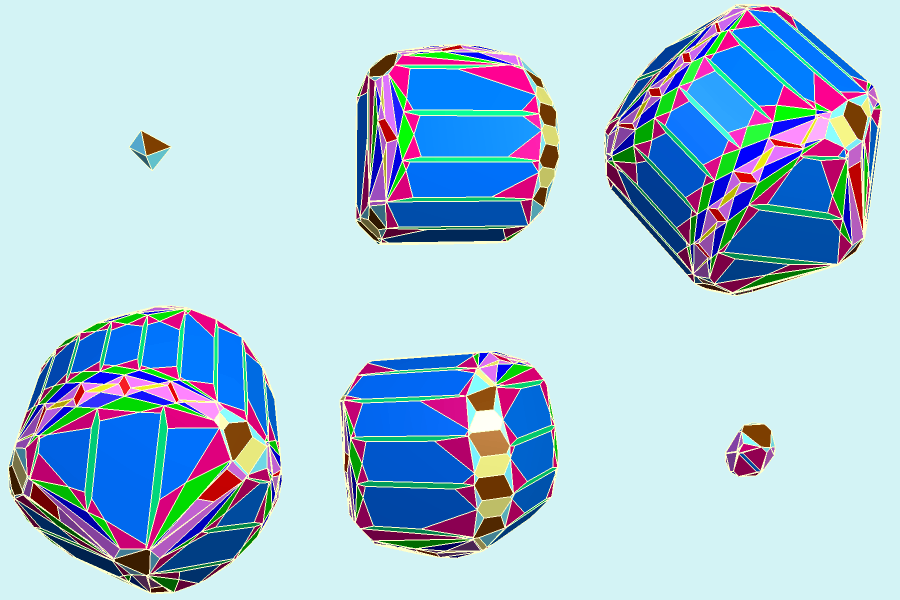

15-Stettic Symmetry - [3,3:15] order 720. It has four sets of 120 points which have kitrippic symmetry. It has 6 girdles (ghost ring which is part of white space) with skew-60-gonic symmetry. It has two sets of four rings that swirl about each other with 30-gonal symmetry which generate 240 kitrigonal regions (60 per ring). It has 180 cross rings with essic symmetry which generate 360 essic regions. Each of the swirl rings have three cross rings meeting in triplicate at two opposite points, there are 30 triples of rings (90 in all) that meet at each swirl ring. White space generates 720 no sym spots.

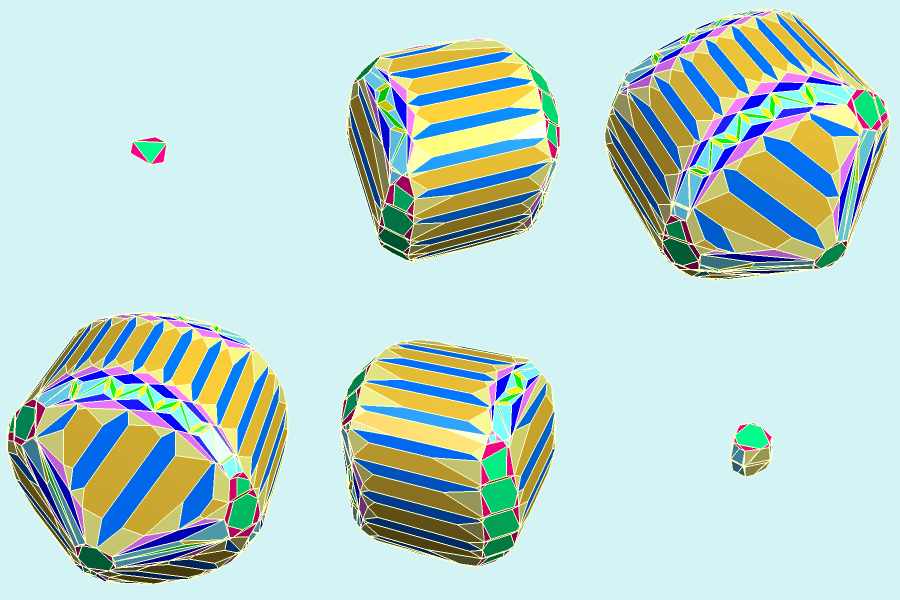

18-Stettic Symmetry - [3,3:18] order 864. It has four sets of 144 points with kitrippic symmetry. Also two sets of 216 points with kibrick symmetry. There are two sets of four swirling rings which have 36-gonal symmetry and generate 288 kitrigic areas each. There are also six swirling rings with 36-gonal symmetry which generate 432 essic spots. There's also two sets of 108 crossing rings which have rectic symmetry generating 432 spots each with essic symmetry. White space form 864 areas with no symmetry.

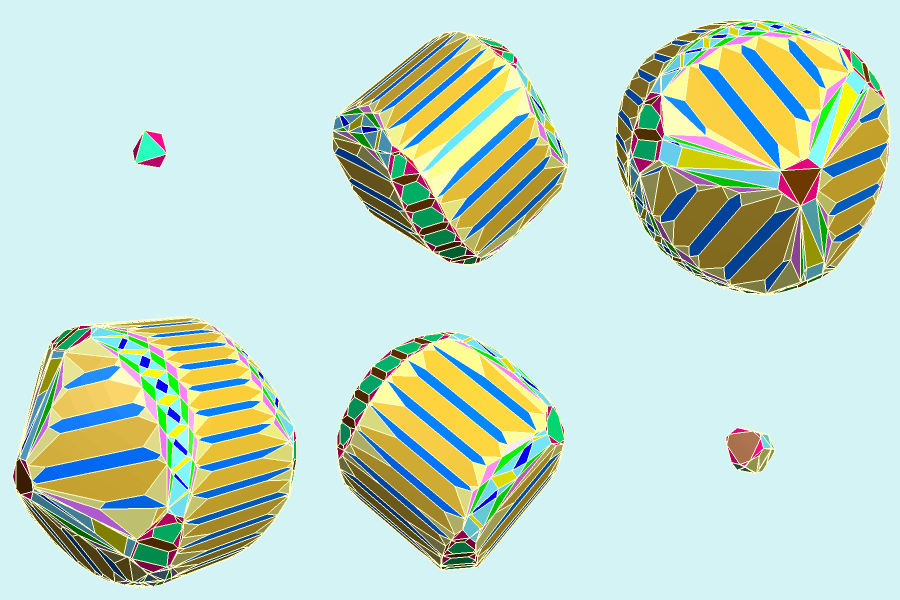

These are the symmetries that Conway refered to as [T x C2n]. As n approaches infinity, these symmetries approach kitetteric symmetry. I coded these using the quarternion set ico1 x cn1. When N is even, then there are six swirl rings with ki-2N symmetry which generate 12N essic areas. When N is odd, the six swirl rings are ghosted and form girdles in white space instead which have skewed ki4N symmetry. When N is divisible by 3, then there are two sets of four swirl rings with ki-2N symmetry, these form 8N kitrigic areas for each ring set (2N spots per ring). When N is not divisible by 3, then the rings are ghosted into white space, but do form girdles with ki-6N/3 gyrogon symmetry. White space creates 24N no sym areas. There are no cross rings.
1-Skitettic Symmetry - [3,3:1]⁺ order 24. All spots generate 24 areas with no symmetry. There are two sets of four ghost girdles with ki-6/3 gyrogon symmetry and a set of six ghost girdles with skewed kisquare symmetry.


2-Skitettic Symmetry = 1-Spyritic Symmetry - [3,3:2]⁺ order 48. There are six swirl rings with kisquare symmetry which generate 24 essic areas. There are two sets of four ghost girdles with ki-12/3 gyrogon symmetry. White space generates 48 no sym areas.


3-Skitettic Symmetry - [3,3:3]⁺ order 72. There are two sets of four rings which has kihigic symmetry which generates 24 kitrigic areas each and a set of six ghost girdles with skewed ki12-gon symmetry. White space generates 72 no sym areas.

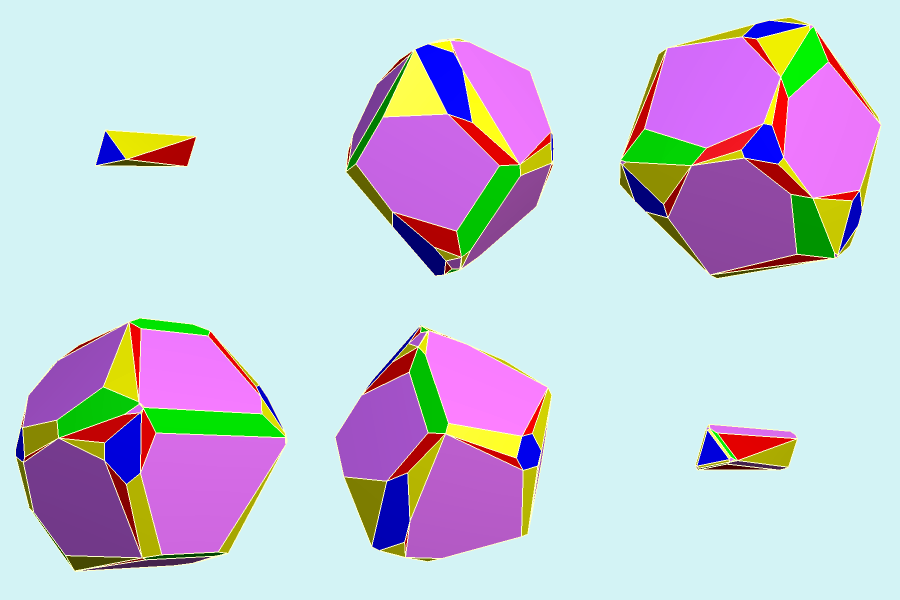

4-Skitettic Symmetry - [3,3:4]⁺ order 96. There are six rings with kioctagon symmetry which generates 48 essic areas and two sets of four ghost girdles with ki-24/3 gyrogon symmetry. White space generates 96 no sym areas.

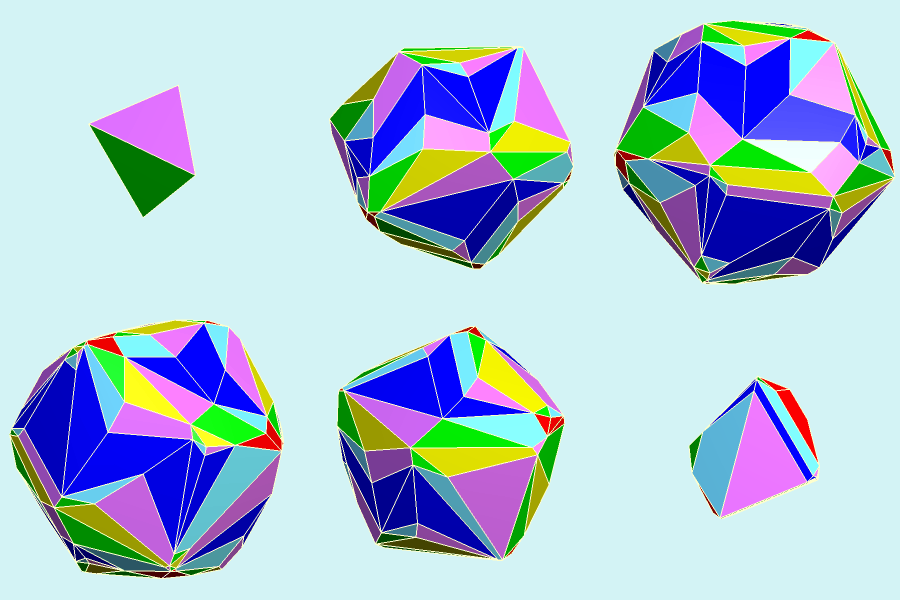

5-Skitettic Symmetry - [3,3:5]⁺ order 120. All spots generate 120 areas with no symmetry. Girdles form, but with no distinction of what forms at them. There are two sets of four girdles with ki 30/3-gyrogonic symmetry and a set of six girdles with skewed 20-kigonic symmetry swirling about each other.



6-Skitettic Symmetry - [3,3:6]⁺ order 144. There are two sets of four swirling rings with kidodecagon symmetry which generate 48 kitrigic spots each, and six swirl rings with kidodecagonal symmetry which generate 72 essic spots. Any point on the rings will generate 12 spots for each similar ring. All other spots generate 144 spots with no symmetry.


7-Skitettic Symmetry - [3,3:7]⁺ order 168. Everywhere is white space which generates 168 no sym areas. There are ghost girdles, six of one type with skewed ki-28-gon symmetry and two sets of four with ki-42/3-gyrogon symmetry.



8-Skitettic Symmetry - [3,3:8]⁺ order 192. There are six rings with ki-16-gon symmetry which generates 96 essic areas and two sets of four ghost girdles with ki-48/3 gyrogon symmetry. White space generates 192 no sym areas.

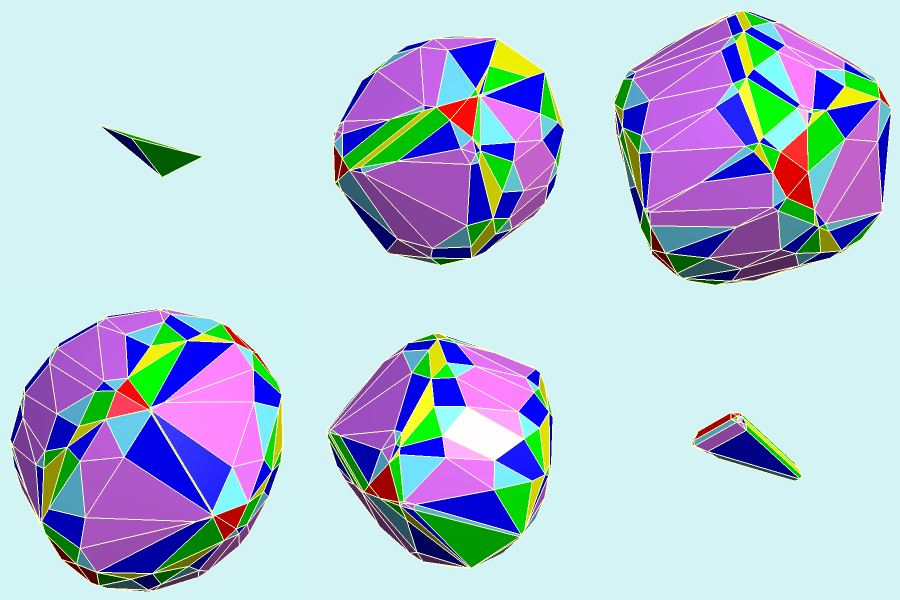

9-Skitettic Symmetry - [3,3:9]⁺ order 216. There are two sets of four rings which has ki-18-gonic symmetry which generates 72 kitrigic areas each and a set of six ghost girdles with skewed ki36-gon symmetry. White space generates 216 no sym areas.

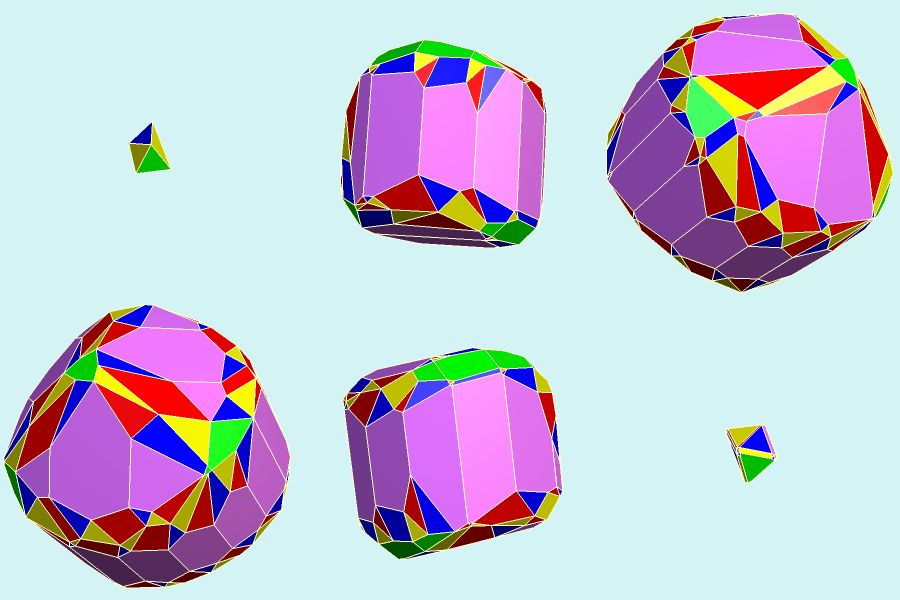

10-Skitettic Symmetry - [3,3:10]⁺ order 240. There are six rings with ki-20-gon symmetry which generates 120 essic areas and two sets of four ghost girdles with ki-60/3 gyrogon symmetry. White space generates 240 no sym areas.


12-Skitettic Symmetry - [3,3:12]⁺ order 288. There are two sets of four swirling rings with ki24-gon symmetry which generate 96 kitrigic spots each, and six swirl rings with ki24-gonal symmetry which generate 144 essic spots. Any point on the rings will generate 24 spots for each similar ring. All other spots generate 288 spots with no symmetry.


15-Skitettic Symmetry - [3,3:15]⁺ order 360. There are two sets of four rings which has ki30-gonic symmetry which generates 120 kitrigic areas each and a set of six ghost girdles with skewed ki60-gon symmetry. White space generates 360 no sym areas.
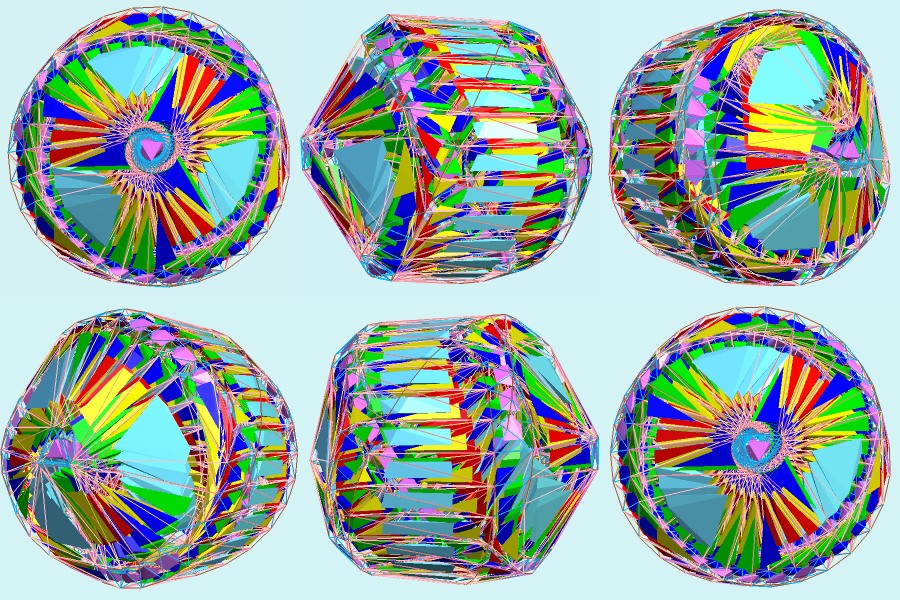


18-Skitettic Symmetry - [3,3:18]⁺ order 432. There are two sets of four swirling rings with ki36-gon symmetry which generate 144 kitrigic spots each, and six swirl rings with ki36-gonal symmetry which generate 216 essic spots. Any point on the rings will generate 36 spots for each similar ring. All other spots generate 432 spots with no symmetry.


These are the symmetries that Conway refered to as 1/6[O x D6n]. As n approaches infinity, these symmetries approach tetteric symmetry. I coded these using the quarternion sets hex4 x cn1, hex5 x cn1+1/3, hex6 x cn1+2/3, hex1 x cn2, hex2 x cn2+1/3, and hex3 x cn2+2/3. When N is even, then there are six swirl rings with 2N symmetry which contains two sets of 12N points with kibrick symmetry and the rings generate 24N essic areas. When N is odd, the six swirl rings are ghosted and form girdles in white space instead and the points vanish, these girdles have skewed 4N symmetry. When N is not divisible by 3, then there are two sets of 8N points with kitrippic symmetry and two sets of four swirl rings with 2N symmetry, these form 16N kitrigic areas (4N spots per ring), there's also a set of four girdles with 6N/3 gyro symmetry which are ghosted into white space. When N is divisible by 3, then the points here vanish and the rings are ghosted into white space, but do form girdles with 6N/3 gyrogon symmetry. White space creates 48N no sym areas. There are also cross rings which generate 24N essic areas for each cross ring set. The cross rings have rectic symmetry when N is even and essic symmetry when N is odd. When N is odd there's one set of 12N cross rings. When N is even then there are two sets of 6N cross rings.
1-Astettic Symmetry - [3;3:1] order 48. There are two sets of eight points with kitrippic symmetry. Four swirl rings going through the points have rectic symmetry generating 16 kitrig areas. There are also four ghost girdles with 6/3 gyrogon symmetry and six ghost girdles with skew square symmetry. There are twelve cross rings with essic symmetry generating 24 essic spots. White space generates 48 areas with no sym.


2-Astettic Symmetry - [3;3:2] order 96. There are two sets of 16 points with kitrippic symmetry and two sets of 24 points with kibrick symmetry. There are four swirling rings going through the kitrippic points with square symmetry generating 32 kitrig symmetric spots. There are six swirling rings going through the kibrick points with square symmetry generating 48 essic areas. Four ghost girdles also exist with 12/3 gyrogon symmetry. There are also two sets of twelve rectic cross rings that intersect each other, they go through both sets of kibrick points and one set of the kitrippic points each. These generate 48 essic areas each. White space generates 96 no sym spots.


3-Astettic Symmetry - [3;3:3] order 144. There are two sets of four ghost girdles with 18/3 gyrogon symmetry and one set of six ghost girdles with skew dodecagon symmetry which are part of white space. There are 36 cross rings with essic symmetry which generate 72 essic areas. White space creates 144 no sym spots.


4-Astettic Symmetry - [3;3:4] order 192. There are two sets of 32 points with kitrippic symmetry and two sets of 48 points with kibrick symmetry. There are four swirling rings with octagon symmetry which generate 64 kitrig areas and six swirling rings with octagon symmetry which generate 96 essic areas. There are also four 24/3 gyrogonal ghost girdles. There are two sets of 24 cross rings with rectic symmetry which generate 96 essic areas, one type for each of the kibrick point sets and meets these points four times, two times in two orientations. White space creates 192 no sym areas.


5-Astettic Symmetry - [3;3:5] order 240. There are two sets of 40 points with kitrippic symmetry. There are four swirl rings with decagonal symmetry that generate 80 kitrigic areas. There are also four 30/3 gyrogonal and six skew icosagonal ghost girdles. There are 60 cross rings with essic symmetry generating 120 essic areas. White space generates 240 no sym areas.


6-Astettic Symmetry - [3;3:6] order 288. There are two sets of 72 points with kibrick symmetry. There are two sets of four ghost girdles with 36/3-gyrogonal symmetry and a set of six rings with dodecagonal symmetry which generate 144 essic areas. There are two sets of 36 cross rings with rectic symmetry that generate 144 essic areas each. White space generates 288 no sym areas.


7-Astettic Symmetry - [3;3:7] order 336. There are two sets of 56 kitrippic points. There are four swirl rings with 14-gon symmetry which generate 112 kitrigic areas which go through the kitrippic points. There are also four ghost girdles with 42/3 gyrogonal symmetry and six ghost girdles with skew 28-gon symmetry which are part of white space. It has 84 cross rings with essic symmetry which generate 168 essic areas. White space generates 336 no sym areas.


8-Astettic Symmetry - [3;3:8] order 384. There are two sets of 64 points with kitrippic symmetry and two sets of 96 points with kibrick symmetry. There are four swirling rings with 16-gon symmetry which generate 128 kitrig areas and six swirling rings with 16-gon symmetry which generate 192 essic areas. There are also four 48/3 gyrogonal ghost girdles. There are two sets of 48 cross rings with rectic symmetry which generate 192 essic areas, one type for each of the kibrick point sets and meets these points four times, two times in two orientations. White space creates 384 no sym areas.


9-Astettic Symmetry - [3;3:9] order 432. There are two sets of four ghost girdles with 54/3 gyrogon symmetry and one set of six ghost girdles with skew 36-gon symmetry which are part of white space. There are 108 cross rings with essic symmetry which generate 216 essic areas. White space creates 432 no sym spots.


10-Astettic Symmetry - [3;3:10] order 480. There are two sets of 80 points with kitrippic symmetry and two sets of 120 points with kibrick symmetry. There are four swirling rings with 20-gon symmetry which generate 160 kitrig areas and six swirling rings with 20-gon symmetry which generate 240 essic areas. There are also four 60/3 gyrogonal ghost girdles. There are two sets of 60 cross rings with rectic symmetry which generate 240 essic areas, one type for each of the kibrick point sets and meets these points four times, two times in two orientations. White space creates 480 no sym areas.


12-Astettic Symmetry - [3;3:12] order 576. There are two sets of 144 points with kibrick symmetry. There are two sets of four ghost girdles with 72/3-gyrogonal symmetry and a set of six rings with 24-gonal symmetry which generate 288 essic areas. There are two sets of 72 cross rings with rectic symmetry that generate 288 essic areas each. White space generates 576 no sym areas.

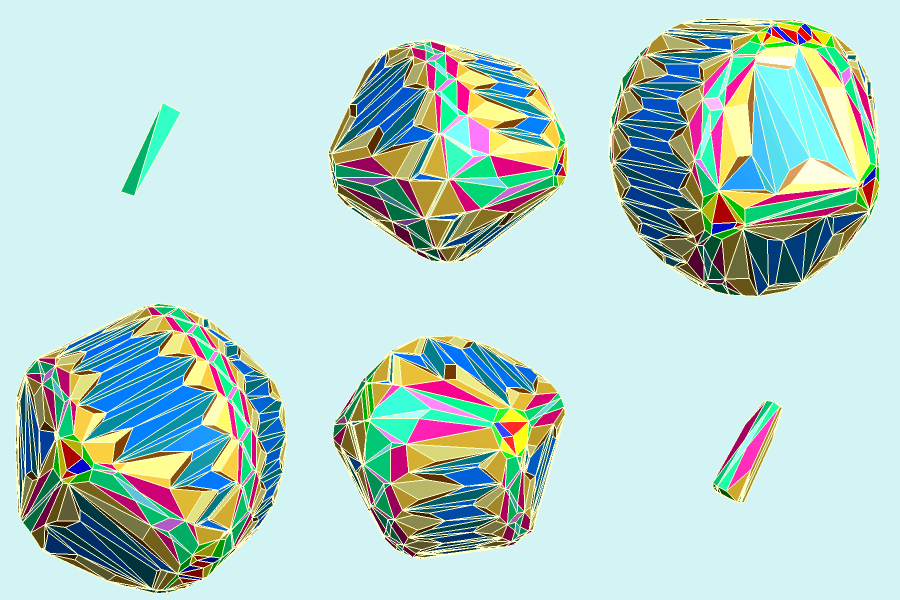

15-Astettic Symmetry - [3;3:15] order 720. There are two sets of four ghost girdles with 90/3 gyrogon symmetry and one set of six ghost girdles with skew 60-gon symmetry which are part of white space. There are 180 cross rings with essic symmetry which generate 360 essic areas. White space creates 720 no sym spots.

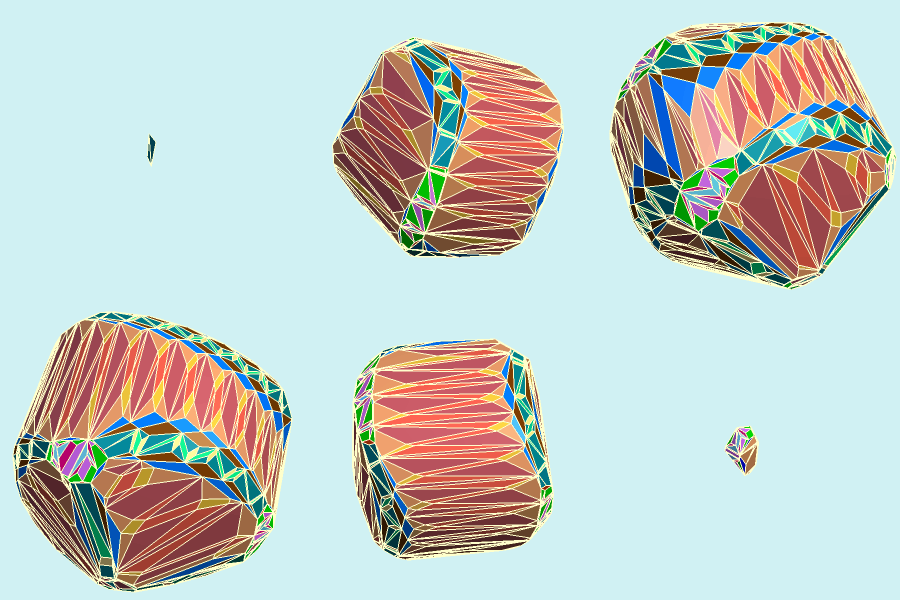

18-Astettic Symmetry - [3;3:18] order 864. There are two sets of 216 points with kibrick symmetry. There are two sets of four ghost girdles with 108/3-gyrogonal symmetry and a set of six rings with 36-gonal symmetry which generate 432 essic areas. There are two sets of 108 cross rings with rectic symmetry that generate 432 essic areas each. White space generates 864 no sym areas.



These are the symmetries that Conway refered to as 1/3[T x C3n]. As n approaches infinity, these symmetries approach kitetteric symmetry. I coded these using the quarternion sets hex4 x cn1, hex5 x cn+1/3, and hex6 x cn+2/3. When N is even, then there are six swirl rings with ki-2N symmetry which generate 12N essic areas. When N is odd, the six swirl rings are ghosted and form girdles in white space instead which have skew ki-4N gon symmetry. When N is not divisible by 3, then there are four swirl rings with ki-2N symmetry, these form 8N kitrigic areas (2N spots per ring). There are also four girdles which are ghosted into white space with ki 6N/3 gyrogon symmetry. When N is divisible by 3, then the rings are ghosted into white space, but do form girdles with ki 6N/3 gyrogon symmetry. White space creates 24N no sym areas. There are no cross rings.
1-Askitettic Symmetry - [3;3:1]⁺ order 24. There are four swirling rings with essic symmetry generating eight spots with kitrigic symmetry. There's also four ghost ring girdles with ki 6/3-gyrogon symmetry and six ghost ring girdles with skew kisquare sym which are part of white space. The white space generates 24 no sym areas.


2-Askitettic Symmetry - [3;3:2]⁺ order 48. There are four swirling rings with kisquare symmetry generating 16 spots with kitrig symmetry. There are also six rings with kisquare symmetry generating 24 spots with essic symmetry. There are also four ghost ring girdles with ki 12/3 gyrogon symmetry. White space generates 48 no sym areas.


3-Askitettic Symmetry - [3;3:3]⁺ order 72. Everywhere is white space generating 72 no symmetric areas. There are two sets of 4 girdles with ki 18/3 gyrogon symmetry and a set of 6 girdles with skew kidodecagon symmetry, all ghosted.



4-Askitettic Symmetry - [3;3:4]⁺ order 96. There are four swirling rings with kioctagonal symmetry generating 32 kitrig areas. There are four ghosted girdles also with ki 24/3 gyrogon sym. There are six swirling rings with kioctagon symmetry generating 48 essic areas. White space generates 96 no sym spots.

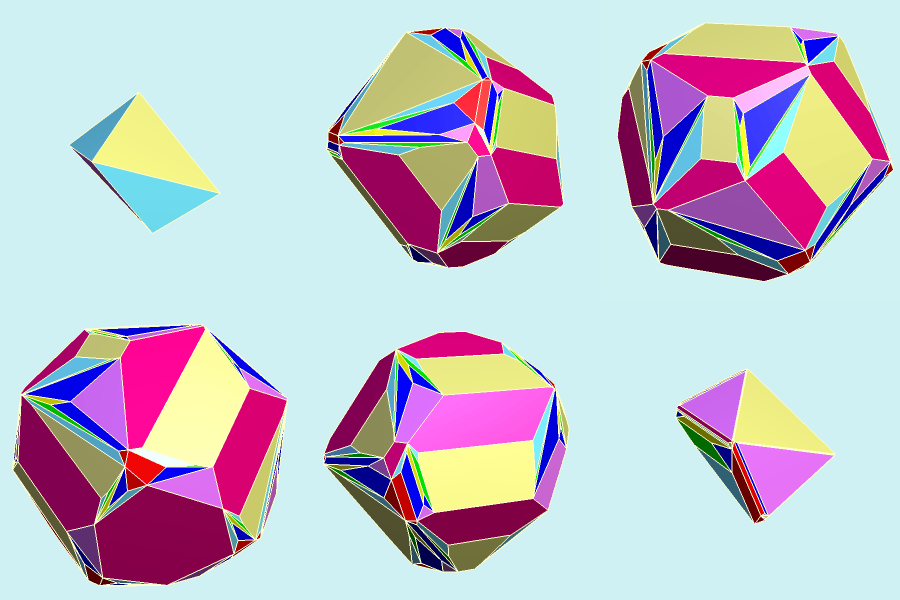

5-Askitettic Symmetry - [3;3:5]⁺ order 120. There are four swirling rings with kidecagonal symmetry generating 40 kitrig areas. There are also four ghost girdles with ki 30/3 gyrogon symmetry and six more ghost girdles with skew kiicosagon symmetry. White space generates 120 no sym areas.

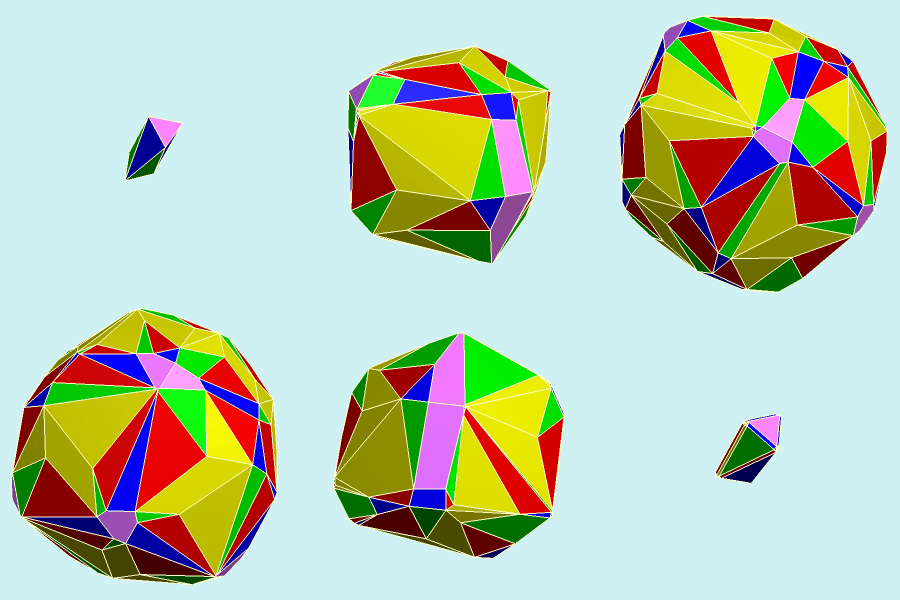

6-Askitettic Symmetry - [3;3:6]⁺ order 144. There are six swirling rings with kidodecagonal symmetry generating 72 essic areas and two sets of four ghost girdles with ki 36/3 gyrogon symmetry, the ghost girdles are part of white space. White space generates 144 no sym areas.


7-Askitettic Symmetry - [3;3:7]⁺ order 168. There are four rings with ki14gon symmetry generating 56 kitrig areas. The four ghost girdles have ki 42/3 gyrogon sym and the six ghost girdles hav skew ki28gon symmetry. White space generates 168 no sym areas.

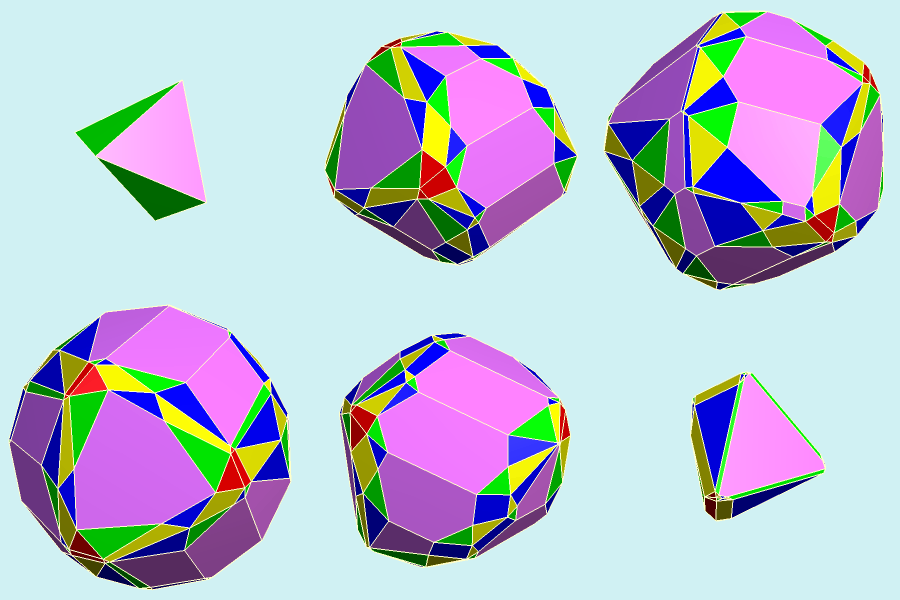

8-Askitettic Symmetry - [3;3:8]⁺ order 192. There are four swirling rings with ki16-gonal symmetry generating 64 kitrig areas. There are four ghosted girdles also with ki 48/3 gyrogon sym. There are six swirling rings with ki16-gon symmetry generating 96 essic areas. White space generates 192 no sym spots.


9-Askitettic Symmetry - [3;3:9]⁺ order 216. Everywhere is white space generating 216 no symmetric areas. There are two sets of 4 girdles with ki 54/3 gyrogon symmetry and a set of 6 girdles with skew ki36-gon symmetry, all ghosted.



10-Askitettic Symmetry - [3;3:10]⁺ order 240. There are four swirling rings with ki20-gonal symmetry generating 80 kitrig areas. There are four ghosted girdles also with ki 60/3 gyrogon sym. There are six swirling rings with ki20-gon symmetry generating 120 essic areas. White space generates 240 no sym spots.


12-Askitettic Symmetry - [3;3:12]⁺ order 288. There are six swirling rings with ki24-gonal symmetry generating 144 essic areas and two sets of four ghost girdles with ki 72/3 gyrogon symmetry, the ghost girdles are part of white space. White space generates 288 no sym areas.
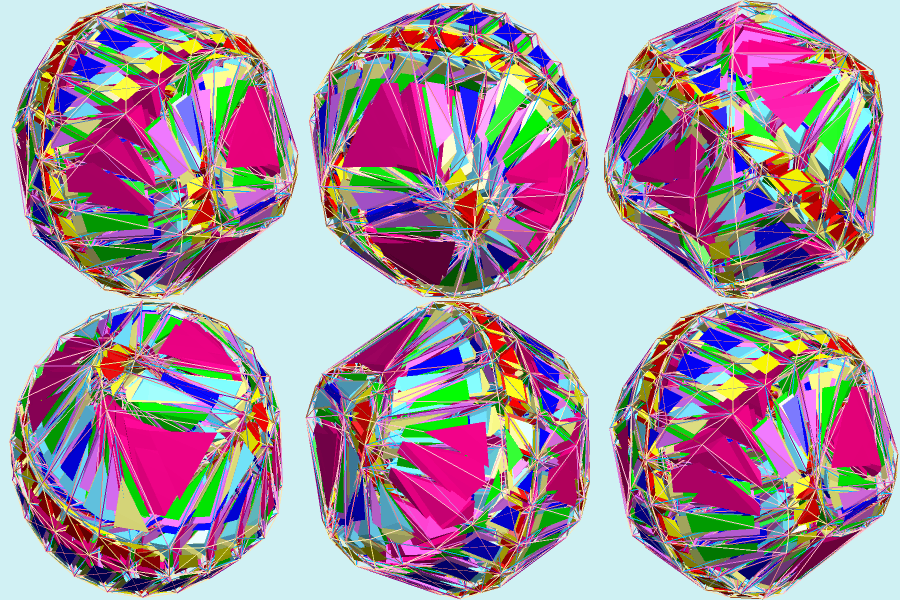


15-Askitettic Symmetry - [3;3:15]⁺ order 360. Everywhere is white space generating 360 no symmetric areas. There are two sets of 4 girdles with ki 90/3 gyrogon symmetry and a set of 6 girdles with skew ki60-gon symmetry, all ghosted.
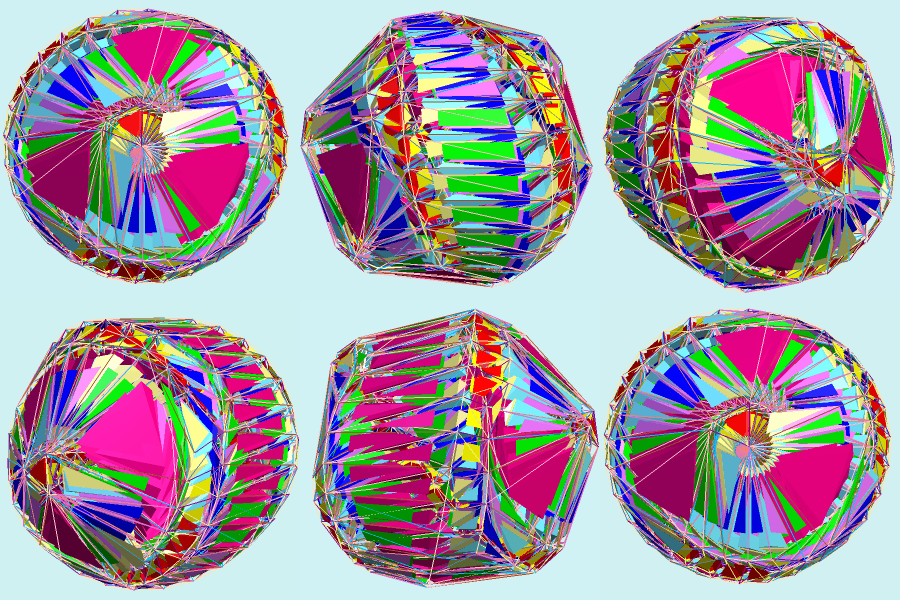


18-Askitettic Symmetry - [3;3:18]⁺ order 432. There are six swirling rings with ki36-gonal symmetry generating 216 essic areas and two sets of four ghost girdles with ki 108/3 gyrogon symmetry, the ghost girdles are part of white space. White space generates 432 no sym areas.


Four Dimensional Symmetries - Part 3 - Swirl Symmetries . . . Four Dimensional Symmetries - Part 5 - Swirlcubic Symmetries
Back to Polychoron Site . . . Home Page

Page created by Jonathan Bowers, 2021
e-mail = hedrondude at suddenlink dot net